The development of our
Co-employers’ best asset – the employees

Human Resources outsourcing involves hiring an outside firm to handle a company’s HR needs and responsibilities, including payroll, hiring/firing employees, filing compliance paperwork, training, adjudicating employee disputes, and much more.
These firms are known as PEOs or Professional Employer Organizations, as they handle the more cumbersome and potentially mundane aspects of running a business. The PEO allows businesses to focus their time and resources on research, development, growth, and other facets of running a successful company.
The people who work for your company are one of its most valuable and important assets. Therefore, you want a human resources (HR) team that respects what they offer and can maximize their potential. You want a team that understands employment laws and other compliance issues. For instance, if an employee files a complaint, you want to be sure that the company takes it seriously and doesn’t engage in any actions that could be misconstrued as harassment or retaliation.
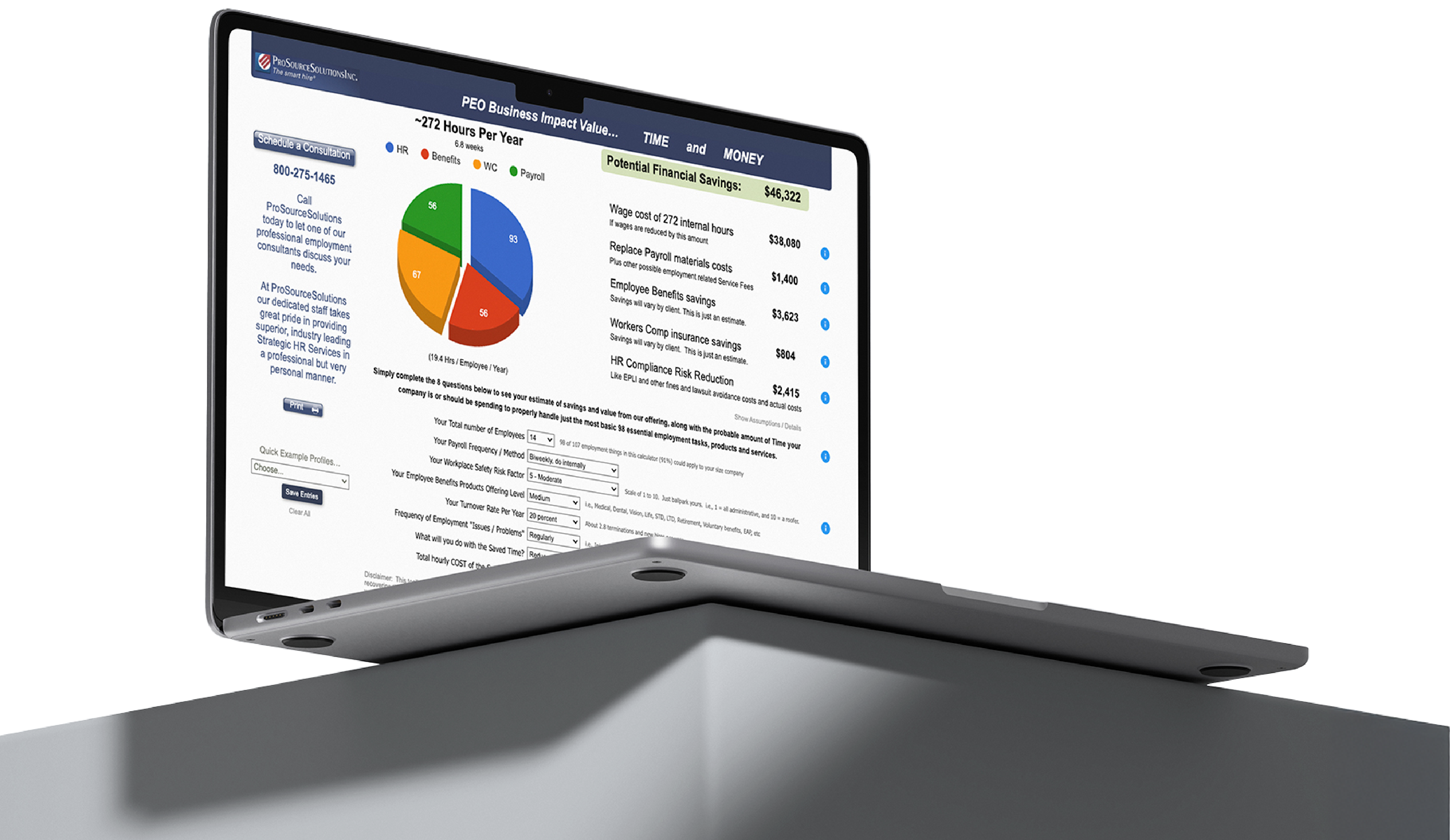
Outsourcing your HR department can save both time and money as a third-party provider will have systems in place to meet your needs and budget. In addition to taking care of day-to-day issues, the folks at ProSourceSolutions can also help your business accomplish its long-term goals.
ProSourceSolutions is a Houston-based PEO and has handled HR for Texas employers since 1999.
ProSourceSolutions is the premier HR outsourcing services company. Our dedicated experts will ensure that all HR-related facets of your business are taken care of correctly and in a timely manner, allowing you to focus on growing your business and taking it to the next level.
A common misconception about outsourcing HR services is that it results in less power for the business and that it hands control of its company to another agency. This is not the case with us, as ProSourceSolutions prides itself on its ability to manage employees and administrative or clerical tasks on behalf of its partners while still allowing the company full control of its operations.
Instead, our core focus is to improve businesses by enabling them to outsource HR functions to our experts. This will enable them to flourish without having to worry about meeting governmental reporting deadlines or spending too much money training employees who will leave after six months for another job.
With ProSourceSolutions, employee development has always been our number one priority. Happier, productive employees are more likely to stay within their companies, which saves money on training and other expenses.
We also offer both tactical and strategic HR services. Tactical HR involves day-to-day operational tasks like posting recruitment ads, employee communication, and dispute resolution. These generally aim to achieve short-term goals to be completed in a year or less.
Strategic HR works towards achieving long-term goals, generally within about five years. These include SWOT (Strengths, Weaknesses, Opportunities, Threats) analysis and other forms of identifying solutions to issues or potential issues that may arise. With this combination, your company will be ready for anything that might happen in the future.
Outsourcing HR services can provide massive benefits and accelerate potential growth, no matter the size of your business or how long you’ve been in operation. ProSourceSolutions can help revolutionize your understanding of Human Resources and lead you to higher growth and revenue.

The focus of the ProSourceSolutions Human Resource Group will always be the development of our Co-employers’ best asset – the employees.
By using effective and efficient use of your Human Capital we can help you remain competitive and fulfill your organizational goals.

The administrative role and also the most time consuming and costly of HR focuses on dealing with government compliance issues, liability protection and record keeping. Typical administrative functions include Employee payroll, benefits administration, Workers Comp claims and Unemployment claims.

The Tactical role of ProSourceSolutions’ HR group involves those day-to-day tasks necessary to run an organization. A variety of activities – recruiting for job openings, resolving employee complaints, and communicating with employees are very typical of our Human Resource department’s tactical role.
A tactical HR plan is a course of action to achieve short-term goals, generally within a year or less. Tactical plans represent the short-term efforts to achieve the strategic, longer-term goals. They are concerned with Job descriptions, skill sets, core competencies, how they must do it and who has the responsibility.
Strategic HR is a course of action designed to achieve long-range goals, generally up to five years. Strategic plans reflect the company’s direction and its purpose as stated in its mission statement. In order to develop strategic plans, top management must develop and use summary reports on finances, operations and the external environment.
We help business owners with the SWOT analysis and by using our PSS Excellence System we help motivate employees to their highest potential. Our system utilizes the tried and true technique of JOB-GOAL-REVIEW to identify performance and potential and help our co-employers to grow.
A small HR team may be ready for outsourcing when routine responsibilities start exceeding its capacity. Rising compliance risk, payroll problems, and limited time for strategic work can all signal that it’s time to consider additional HR support.
If your HR team is experiencing any of the following challenges, it may be time to consider outsourcing HR services.
If these issues aren’t addressed early, they can lead to more serious risks, including IRS penalties, union involvement, compliance issues, and costly payroll errors.
Outsourcing these common pain points can reduce administrative pressure while giving your business access to dedicated support.
Outsourcing payroll can reduce the administrative workload involved in calculating wages, managing deductions, and keeping payroll processes accurate and on schedule. ProSourceSolutions provides payroll services to help businesses manage their pay efficiently.
Outsourcing benefits administration gives your business support by managing employee benefit programs. This helps provide greater appeal for employees in your workplace environment.
When hiring demands begin to exceed your internal capacity, outsourcing recruiting can provide additional support throughout hiring processes.
Employee training can become difficult to manage and keep track of as your workforce grows. Outsourcing training can give your business access to structured programs that help employees build relevant skills while reducing the workload on your internal HR team.
Outsourcing employment law support gives your business access to specialist guidance when navigating employment-related requirements and potential compliance risks.
At ProSourceSolutions, we know that transitioning to outsourced HR works best when you move through the process in planned stages.
Begin by documenting every HR responsibility your team currently manages.
From payroll and benefits to recruiting and compliance. Make note of the time and internal costs associated with each function; this will support you in identifying where outsourcing could provide the greatest benefit.
Separate strategic and daily responsibilities based on what your business needs to retain internally. Keep functions that require direct business oversight and identify routine, administrative, or specialist HR tasks that could be outsourced.
Shortlist providers that can support the HR functions you plan to outsource, from payroll and benefits to recruiting and compliance. Look for a partner with the right experience and services. At ProSourceSolutions, we offer a range of HR services designed to support growing businesses.
Prepare employee records, payroll information, and other HR data before the transition begins. Your new provider should be able to assist you in noting clear responsibilities and deadlines, so your information is transferred accurately, and the payroll can move across without disruption.
Test the new process by running one payroll cycle in parallel before fully switching. Use this time to check employee information, catch errors, and fix any issues before the final handover.
More often than not, the decision to outsource human resources (HR) is met with hesitation. Some people swear by it, others are convinced it’s too risky, too expensive, or simply not worth it unless you’ve got hundreds of staff. The reality is different. Outsourcing HR has become a smart, cost-effective way for businesses of all sizes to stay compliant, manage people well, and free up valuable time.
Fact: HR for smaller and mid-sized businesses is often needed more.
A large company usually has its own HR department, compliance officers, and the budget to cover mistakes. Small and mid-sized businesses typically don’t. But the obligations remain the same.
For example, consider a 15-person civil engineering firm. They don’t need a full-time HR manager, but they do need someone to ensure payroll is accurate, workplace safety is compliant, and employment contracts meet federal and state labor standards. Outsourcing gives them access to that expertise without the cost of a permanent hire.
Fact: It actually saves money in the long run.
Hiring in-house staff comes with more than just wages. There’s health insurance, paid leave, workers’ comp, payroll software, ongoing training, and office space. For many businesses, outsourcing costs far less than even a single HR manager’s salary.
And then there are the hidden costs of mistakes. A labor law violation or payroll error can lead to fines, back pay claims, or even lawsuits. Fixing those can run into tens of thousands of dollars. Outsourcing helps reduce that risk.
Fact: Data is usually safer with a professional provider.
Understandably, a lot of people worry about handing over sensitive employee data. But outsourcing companies are bound by strict privacy laws and invest heavily in security, far more than most small businesses can. Encrypted payroll systems, restricted access, and compliance with American data standards are standard practice.
Compare that to payroll records stored on one office computer or emailed back and forth between staff. In many cases, outsourcing tightens data security rather than weakening it.
Fact: Good outsourcing feels like an extension of your team.
A common fear is that you’ll get stuck in a call center queue, having to explain your business from scratch every time you need help. That might have been true years ago with some providers, but the industry has evolved.
Today, most reputable firms assign you a dedicated contact or small team who learn your business, understand your industry, and become your go-to resource for advice. A construction company wants someone who understands safety regulations and trade classifications. A law firm wants someone who knows the nuances of professional services.
Fact: It prevents them.
Far from creating risk, HR outsourcing helps reduce it. Providers stay on top of every workplace law change, benefits requirement, and industry regulation update. Their job is to keep you compliant. They also understand the tax implications that come with payroll and employee benefits. Instead of worrying about what you might be missing, you get peace of mind knowing someone else is staying ahead of it.
In Deloitte’s 2022 Global Outsourcing Survey, 57% of executives said their companies rely on external providers for HR services. The reasons are usually quite straightforward.
Got questions?
We’ve got answers.
Outsourcing human resources can provide many benefits to companies. First, let’s look at some potential financial benefits. Under traditional systems, a company hires and trains a Human Resources Department staff to manage the company’s administrative and clerical tasks.
With HR PEO services, these companies can instead pay a simple monthly fee to another company to handle that work. For many companies, not having to pay anyone overtime will present an immediate savings.
Here’s an example using rough figures to explain the potential savings in concrete terms. Imagine a company that hires three full-time HR employees who are all paid $20 an hour. Assuming no one gets any overtime, those three employees would collectively be paid $2,400 a week or nearly $125,000 per year, not including benefits or training costs.
It also benefits the company from a liability standpoint. For example, under the traditional system, a company that files late paperwork for something like a city or municipality’s sales tax bill would be subject to fines in the form of late fees. With managed HR services, the company would not be held liable.
In short, by outsourcing HR functions, companies can save significant time and headaches, reduce their liability in certain circumstances, and be able to spend more time focused on ensuring that business operations are running as smoothly, efficiently, and as profitably as possible.
HR outsourcing can benefit companies of all sizes, from multi-billion dollar international conglomerates on the Fortune 500 to small software companies with only a handful of employees.
Handling human resources for a large company with many satellite offices in different locations can be a daunting task. It can also be difficult to sort and maintain all the paperwork associated with all of those employees. Outsourcing these duties will reduce expenses and improve efficiency by allowing the two companies to synergize their core strengths for mutual benefit.
Smaller businesses can also benefit, as explained in more detail in the next section. Startups, in particular, can benefit from outsourcing HR services by freeing up more time for the core staff to focus on their product or service. The first few months after a business is incorporated are essential to the company’s sustained success, which makes the benefits of HR outsourcing clear.
It also benefits medium-sized businesses that may have plateaued or wish to increase their growth further. Issues like employee retention, interpersonal conflicts, and company operations being spread too thin can hamper a company’s growth. With outsourced HR services, these companies will be in a better position to focus on daily operations and increase revenue and market share.
In short, nearly every business can benefit from outsourcing its HR functions to a PEO. No matter which industry or how many employees a company has, being able to focus on expansion instead of personnel will provide both short-term and long-term growth.
HR outsourcing can be beneficial for small businesses for several reasons. First, having a set amount of money dedicated to HR expenses instead of potentially paying overtime or other costs can be very useful for budgeting purposes.
In addition to financial benefits, there are also intangible ones. For example, all of the time, energy, and resources the company puts into HR can now be redirected elsewhere. This is especially important for small businesses, as these are often created by a single person with a dream.
These entrepreneurs dream of creating a fashion boutique, owning a restaurant, developing software to solve problems, or pursuing other noble goals. However, not many of them have the same passion for filing compliance paperwork or writing and enforcing an employee code of conduct. By outsourcing, leadership can focus on growing and building their dream business instead of worrying about filing all the paperwork properly.
Another issue that outsourcing can alleviate is the ability of small businesses to attract quality talent for their HR departments. Small businesses, especially startups, usually have smaller budgets than their larger counterparts that have been operational for years.
A potential employee with even a few years of HR experience would likely receive higher pay and more benefits at a larger company that can afford to do so. Accordingly, many small businesses struggle to find high-quality candidates willing to work a less prestigious job for a smaller company. With a managed PEO service handling HR hiring, the probability of getting experienced applicants increases significantly.
Another way using a PEO can help attract higher-quality applicants is by allowing small businesses to offer better and more affordable employee benefits. Setting up a healthcare plan for a few employees can result in high premiums and expensive copays. These PEOs represent workers from many fields nationwide, so their benefit packages will undoubtedly be better for employees.
Nearly every standard practice normally performed by a Human Resources Department can be outsourced. Payroll is an important one, as software can be expensive, the process can be time-consuming, and making one small mistake can result in angry employees asking why they’ve been shortchanged.
They can also handle hiring and firing employees, as well as onboarding and training. This is particularly beneficial to smaller businesses, as it allows the boss to oversee operations instead of taking time out of their schedule to get new employees up to speed. The average employee training time in 2021 was 64 hours, which adds up quickly.
For some businesses, the handling and filing compliance paperwork is the most essential part. Worker’s Compensation, Unemployment Insurance, and many other important documents must be filed with the relevant agencies promptly. Not worrying about missing paperwork deadlines can greatly boost any business.
They can also help with succession planning, ensuring that a plan is in place to ensure the business continues and that the future leadership members will have adequate training, time, and preparation before taking the reins.
Additionally, they can use data analytics to interpret financial and operational information and provide solutions or alternatives that can massively benefit the company. These businesses are merely suggestions backed by data, and the business is under no obligation to follow them, but at the very least, they’ll give the company options to consider.